
Kissow Group - Gut Hormone Biology
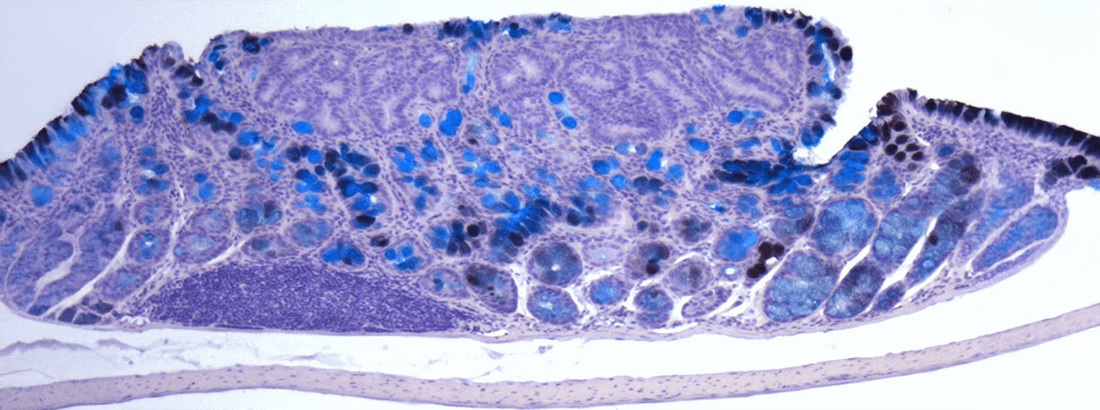
Our main focus in the group is to elucidate how the endogenous gut hormones impacts intestinal healing and recovery. We have a special interest in the influence of dietary fibers on the luminal metabolomics and gut hormone secretion.
We mainly use animals (mice and rats) in experimental models of intestinal diseases. We use GMO mice; we have our own breed of GLP-1 and GLP-2 receptor knock out mice.
We are setting up a model of total parental feeding in a rat. The rats will be fitted with a catheter in the carotid artery and jugular vein; connected to a tether and a swivel, enabling the rats to be unrestrained during infusion and blood sampling.
Laboratory techniques are:
- ELISA
- RIA
- Histology
- IHC
- Morphology
Chemotherapy-induced mucositis is a frequent complication of anticancer treatment. The disease threatens the effectiveness of therapy because it often leads to dose reduction and impairs patients’ quality of life. Patients receiving high dose chemotherapy before hematopoietic stem cell transplantation (HSCT) develop severe toxicities, diarrhea, nausea and insufficient food intake. Further to this, damage to the intestinal epithelium increase the risk of translocation of bacteria, resulting in systemic inflammation in variable degrees, which again increases the body’s energy needs. However, patients are not equally susceptible to the development of severe side-effects, still no method exist to predict who rae in highest risk. Extensive knowledge of the pathophysiological mechanism behind chemotherapy induced intestinal damage could show the way to personalized prophylactic treatment, which would have a great potential for improvement of outcome in this selected patient group.
We think that gut hormones are important for the recovery of the intestinal mucosa upon injury, such as chemotherapy induced mucositis. We have shown that both GLP-1 and GLP-2 treatment were able to reduce the damages to the intestine after injections of chemotherapy in mice and rats. When given in combination the effect was additive. We know that patients with obesity or diabetes have an impaired secretion of both GLP-1 and GLP-2, and that patients undergoing HSCT have an increased fasting level of GLP-1 in plasma. The hormones are secreted from endocrine cells in the epithelial lining. A plethora of both nutrient components, bile acids and metabolites from bacterial fermentation has proven to stimulate secretion of several gut hormones, showing us that luminal stimulation after oral food intake is crucial for the secretion. Poor nutritional status are associated with poor outcome, still nutritional therapy has major challenges. Due to the reduced enteral resorptive capacity, tube feeding is rarely the solution and most patients need total parenteral nutrition (TPN). TPN restores the nutritional status, but on the other hand, the treatment might have severe effects on the intestinal mucosa, due to the impaired gut hormone secretion, again exaggerating the toxicities from the chemotherapy.
Our main target in the group is to elucidate the importance of the endogenous hormones in intestinal healing and recovery. We have a special interest in how dietary fibers impacts the luminal metabolomics and the metabolites ability to induce hormone secretion and intestinal recovery. We are also interested in the therapeutic potential of the hormones; we are conducting a clinical trial in patients undergoing HSCT and high-dose chemotherapy in a collaboration with oncologists from Rigshospitalet.
Klaus Müller, Professor in pediatric oncology at the Department of Pediatrics and Adolescent Medicine at The Juliane Marie Centre, Rigshospitalet.
Vibeke Brix Christensen, Professor in pediatric medicine at the Department of Pediatrics and Adolescent Medicine at The Juliane Marie Centre, Rigshospitalet.
Jens Juul Holst, Professor at Department of Biomedical Sciences
Henrik El Ali, Associate Professor and group leader in EL ALi Group – Lung Physiology and Translational Research
The Kissow Group has received grants from a number of private and public foundations.
Danish Council for Independent Research Medical Sciences (FSS)
Hannelouise Kissow is the grant holder.
Case number: DFF 4004-00620B
The Danish Cancer Society - Valdbjørns Fond
Aase og Ejnar Danielsen Foundation
Fonden til Lægevidenskabens Fremme
Det Lægevidenskabelige Fakultets Fond
Oda og Hans Svenningsens Fond
Krista og Viggo Petersen's Fond
Else og Mogens Wedell-Wedelsborg Fond
Dagmar Marshall fond
Fabrikant Einer Willumsen Mindelegat
Københavns Universitets Fond for Kræftforskning
BRIDGE program
Group members
| Name | Title | Phone | |
|---|---|---|---|
| Aliprandi, Elisabetta | Erasmus Master Student | ||
| Etienne, Grace Brentnellé | Erasmus Master Student | ||
| Helt, Thora Wesenberg | Postdoc | ||
| Kissow, Hannelouise | Associate Professor | +4535326651 | |
| Mustafa, Alisa | Master Student | ||
| Sørum, Maria Ebbesen | Postdoc |

Group Leader
Hannelouise Kissow
Associate Professor
Phone +45 20 27 66 50
Email: kissow@sund.ku.dk
ORCID: 0000-0001-9351-8885